


Río Lagartos: A Coastal Community Shaped by Nature
Río Lagartos is a historic fishing community on the northern coast of Yucatán, surrounded by wetlands, mangroves, coastal lagoons and the protected landscapes of the Ría Lagartos Biosphere Reserve.
The region has been connected to fishing, salt production, navigation and the use of coastal natural resources for generations. Today, these traditional activities coexist with conservation, nature tourism and wildlife observation.
The Maya name traditionally associated with this coastal area is Hol Koben, often interpreted as a reference to an entrance or gateway connected with the coastal world.
Understanding Río Lagartos also means understanding the people who live and work within and around the reserve, as well as the different forms of land ownership and economic activity that have shaped the landscape over time.
People Living and Working in the Ría Lagartos Biosphere Reserve
The Biosphere Reserve is not an isolated wilderness. It is a protected landscape connected to local communities, fishermen, ranchers, landowners, tourism operators and families whose livelihoods depend in different ways on the natural resources of the region.
Conservation therefore involves not only protecting wildlife and habitat, but also managing how people use, work within and interact with the landscape.
Land Ownership Inside the Reserve
Land within and around the reserve includes several forms of ownership and administration.
These include:
- Private property
- Ejido land
- Nuevos Centros de Población Ejidal (NCPE)
- National land
- Federal Maritime-Terrestrial Zone (ZOFEMAT)
What Is an Ejido?
An ejido is a form of communal land tenure in Mexico in which members of a community have rights to use specific parcels of land while certain areas may remain under collective management.
A significant part of the land within the reserve is associated with ejido ownership. Because land use can directly affect habitat, water systems and wildlife, development and productive activities within the protected area are subject to environmental regulations and zoning.
Effective conservation therefore depends not only on legal protection, but also on monitoring, enforcement and cooperation among communities, landowners and government authorities.Rio Lagartos Mayan port , the name in the Mayan language of this town is HOL KOBEN (HOL means the entrance and KOBEN means the kitchen or cuisine of the Mayan world of the coast).
Who Does What Inside the Reserve?
The Ría Lagartos Biosphere Reserve is a protected area where conservation, fishing, ranching, tourism, salt production and community life all coexist.
Because several activities take place within the same landscape, effective management depends on clear regulations, responsible use of natural resources and cooperation between local communities and authorities.
Fishing and Resource Management
Fishing has long been one of the traditional livelihoods of Río Lagartos and surrounding communities.
Different fishing methods are regulated according to species, season, location and environmental conditions. These regulations are intended to protect fish populations, aquatic vegetation and the habitats that support both commercial species and wildlife.
As in many protected areas, the effectiveness of these rules depends on monitoring, enforcement and cooperation among fishermen, authorities and the communities that depend on healthy coastal ecosystems.
Ranching and Land Use
Ranching and agricultural activity also form part of the wider landscape surrounding the reserve.
Because boundaries, land ownership and traditional land use have changed over time, conflicts have occasionally occurred over where productive activities may take place.
Today, land use inside and around the protected area is subject to environmental zoning and regulation intended to reduce habitat loss and protect sensitive ecosystems.
Commercial Fishermen
Commercial fishing remains an important source of income for many families in the region.
At times when fishing activity is reduced by weather, seasonal closures or other conditions, some fishermen also participate in tourism services.
This connection between fishing and tourism reflects an important part of Río Lagartos’ local history, where knowledge of tides, channels, weather and wildlife originally developed through generations of working on the water.
Nature Guides
Professional nature guiding has developed alongside the growth of ecotourism in Río Lagartos.
A trained guide brings a different role to the visitor experience: interpretation of wildlife, identification of species, understanding of habitats, conservation awareness and communication with travelers.
Captains and guides can complement one another. The captain concentrates on navigation and safety, while the guide can focus on helping visitors understand the natural environment.
Salt Production at Las Coloradas
Salt production has been part of the northern Yucatán coast for centuries and remains an important economic activity in the region.
Today, the large saltworks at Las Coloradas form one of the most visible human-modified landscapes near the Ría Lagartos Biosphere Reserve.
The production process depends on a series of shallow evaporation ponds where seawater becomes increasingly concentrated. Changes in salinity, microorganisms and other natural processes can produce the well-known pink coloration seen in some of these ponds.
Although the saltworks are located within the broader coastal landscape of the reserve region, they are an industrial operation and should not be confused with the natural wetlands, mangroves and lagoons that characterize much of the Ría Lagartos ecosystem.
Salt production provides employment and economic activity for local communities, while the surrounding protected area also supports fisheries, wildlife, tourism and conservation.
For this reason, the relationship between industrial activity and environmental protection is an important part of understanding the region.
Las Coloradas and the Natural Reserve
Visitors sometimes assume that the bright pink ponds of Las Coloradas are a natural part of the estuary.
They are not.
The intensely colored ponds are part of the salt-production system, while the Ría Lagartos Biosphere Reserve includes a much wider variety of natural habitats such as mangroves, coastal lagoons, wetlands, dunes, beaches and feeding areas used by wildlife.
These different landscapes are geographically close, but they offer very different experiences.
Las Coloradas is primarily associated with salt production and its distinctive evaporation ponds.
Ría Lagartos is primarily experienced through its natural ecosystems, wildlife and coastal wetlands.
Las Coloradas and Río Lagartos are part of the same coastal region, but they are not the same experience.
Eco-Tours in the Ría Lagartos Biosphere Reserve
Nature tourism has become an important part of Río Lagartos.
Visitors come to experience flamingos, crocodiles, mangroves, birds, coastal landscapes and the traditional character of the community. These experiences can take many forms, from short wildlife boat trips to specialized birdwatching, photography and fishing excursions.
The quality of the experience can vary considerably depending on the knowledge, training and environmental practices of the operator.
Choosing a Responsible Nature Operator
Not everyone offering a boat ride has the same level of training or experience in nature interpretation.
A professional nature guide brings more than transportation. A trained guide can help visitors understand wildlife behavior, identify species, interpret habitats and explain why certain conservation practices are important.
Responsible operators should also respect wildlife distance, avoid feeding animals and never intentionally disturb birds or other species for photographs.
Choosing carefully helps protect the Biosphere Reserve while supporting local people who depend on responsible nature tourism.
Flamingo and Wildlife Boat Tours
Boat excursions to observe flamingos remain one of the best-known experiences in Río Lagartos.
Flamingos move naturally throughout the coastal wetlands according to food availability, water conditions, season and breeding activity. Their location and numbers can therefore change from day to day and throughout the year.
A responsible wildlife experience is not about getting as close as possible.
Boats should approach carefully, maintain an appropriate distance and avoid entering directly into groups of feeding or resting birds. Flamingos should never be deliberately chased or forced to fly for photographs.
The best encounters are those in which visitors can observe natural behavior without altering it.
Birdwatching
Río Lagartos and the surrounding region offer excellent opportunities for birdwatching because several habitats occur close together.
Mangroves, wetlands, coastal lagoons, salt-marsh areas, scrub, savanna and surrounding countryside support a wide variety of resident and migratory species.
Some visitors enjoy birding at a relaxed pace, while experienced birders may arrive with particular species in mind.
Birding can be done both by boat and on land, depending on the species, season and habitat.
For travelers looking for more specialized birding experiences, we now provide that information separately through our dedicated birding resources.
Eso último es importante porque mantiene birding dentro de esta página, pero no compite con BirdingYucatan.com.
Luego seguiría con:
Fly Fishing and Sport Fishing
Fishing is deeply connected to the history and identity of Río Lagartos.
Today, sport fishing offers visitors another way to experience the coastal environment. Tarpon and other species can be targeted using techniques such as fly fishing and light tackle, depending on season and conditions.
Responsible sport fishing should emphasize proper handling and, whenever appropriate, catch-and-release practices.
The goal is not only to catch fish, but also to experience the estuary, understand its habitats and respect the natural systems that support local fisheries.
Crocodile Observation
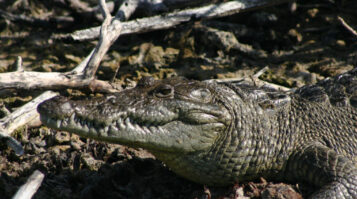
Crocodiles are an important part of the Ría Lagartos ecosystem and can sometimes be observed during boat excursions.
Their activity varies according to temperature, water level, time of day and other natural conditions.
For safety and conservation, crocodiles should never be fed or attracted with bait.
Observation should take place at a respectful distance, allowing the animal to behave naturally.
Aquí sí cambiaría completamente la frase actual de que “can be approached close up and amazing photography usually is possible,” porque hoy puede interpretarse como promover acercamientos excesivos.
Beaches and Coastal Excursions
The Gulf of Mexico coastline can also be reached by boat from Río Lagartos and nearby coastal communities.
These excursions offer a different experience from wildlife observation inside the estuary, with opportunities to enjoy sandy beaches, coastal scenery and the open Gulf environment.
Conditions vary with wind, waves and season, so access and activities should always depend on safe navigation conditions.
Nature Photography
Río Lagartos offers excellent opportunities for nature and wildlife photography.
Birds, flamingos, crocodiles, mangroves, coastal landscapes, traditional fishing scenes and village life can all provide interesting photographic subjects.
The best photography experiences combine good light, patience and responsible distance from wildlife.
For serious photographers, early morning and late afternoon often provide the best combination of softer light and increased wildlife activity.

Petén Mac and the Freshwater Springs

One of the interesting natural features of the Ría Lagartos region is the presence of petenes and freshwater springs within the coastal wetland system.
These freshwater sources create small areas with different vegetation and ecological conditions from the surrounding saline wetlands.
Petén Mac is one example of this type of habitat.
Freshwater emerging within a predominantly coastal and saline environment can support distinctive plant communities and provide important habitat for birds, reptiles and other wildlife.
A Different Side of the Reserve
Visitors often associate Río Lagartos mainly with flamingos and mangroves, but the reserve contains a much wider variety of habitats.
Freshwater springs, petenes, coastal scrub, dunes, lagoons and mangrove forests all form part of the ecological diversity of the region.
These habitats are connected, and each one supports different species and natural processes.
Understanding these less visible parts of the reserve helps explain why Río Lagartos is much more than a single wildlife attraction.

Wildlife and Safety
Petén areas and freshwater springs can also be used by wildlife, including reptiles.
For this reason, visitors should always follow local guidance and avoid entering the water unless conditions and regulations clearly allow it.
Wildlife should be observed from a respectful distance, and natural areas should never be treated as controlled recreational environments.Ojo de agua ” Chiquila”

Río Lagartos is a living landscape where nature, traditional livelihoods, conservation and tourism all meet.
That’s Petén Mac below: